

THE RESISTANCE:
A Team of High-Powered Lawyers and Former Federal Prosecutors Strikes Back Against Trump's Abuse of the Rule of Law

(Note to Readers: This Substack is still about Trump and Medicine. But it’s also about the broader resistance — in this case, a bigtime legal team you probably haven’t heard of. They have won major court battles against Trump and now are fighting to stop the damage to the Kennedy Center.)
Suspended from the pristine white marble at Washington’s Kennedy Center hangs a tarp serving as a giant fig leaf for Donald Trump. It blocks the public’s view of whether he did, or didn’t, take his name off.
Meanwhile, hiding in plain sight is evidence of something far more consequential: The man who now runs the great hall admits he didn’t even evaluate the loss of performances, audiences and donors — the whole reason the Kennedy Center exists — when he decided to shut it down for two years for maintenance.
We know this because of vivid cross-examination testimony in federal court, largely ignored in the furor over the Kennedy Center’s name. The testimony even features the improbable scene of one lawyer wandering out of the courtroom audience to take over questioning.
That attorney, Kyle Freeny, is part of a below-the-radar nonprofit legal team called Washington Litigation Group that now constitutes the forward spear of a national legal resistance. They have already played a big role in forcing Trump’s Department of Justice to drop its dishonest “vandalism” prosecution at Washington’s reflecting pool. In another, they helped block Trump from putting his name on the Kennedy Center. A third, among many, is a little-noticed action to block Trump from firing millions of federal civil-service employees.
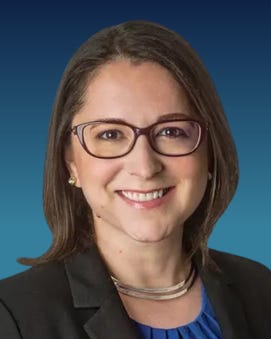
Kyle Freeny of the Washington Litigation Group
None is more consequential than the battle to protect the future and legacy of the John F. Kennedy Center for the Performing Arts. The man whose testimony was so pivotal is Matt Floca, the 39-year-old former Kennedy Center facilities management director who now is Kennedy Center president.
Despite his maintenance background, Floca lacks expertise in the world of Renee Fleming concerts, Mrs. Doubtfire productions or the National Symphony Orchestra tackling Brahms. He even said so in his federal district court testimony April 29.
Irate after Trump launched his administration by pardoning the Jan. 6 Capitol attackers, these attorneys once worked in places like the Department of Justice and the special counsel’s offices of Robert Mueller and Jack Smith. Several also were at top national law firms like Sidley Austin, Milbank, and in Ms. Freeny’s case, Greenberg Traurig.
(Please hit the subscribe button to see all future articles, related to medical research and the broad resistance.)
Washington Litigation Group’s motto is “Defending the Rule of Law.” Its web site reports that it fights, free of charge, for clients “unlawfully targeted by the federal government for exercising their rights.” Contributions are expected to pay for this effort.
Ms. Freeny is one of the group’s growing cast of 15 lawyers. She used to be an attorney for the Department of Justice’s federal programs branch. She also worked in special counsel Robert Mueller’s office, handling such cases as the prosecution of Trump’s campaign manager Paul Manafort.
“Our mission is the rule of law,” she says. “It just happens that the biggest threat to the rule of law right now is Donald Trump.”
Her pivotal role in the Kennedy Center case arose as she sat in the courtroom gallery during testimony from Matt Floca. She took the unusual step of approaching federal district court Judge Christopher Cooper, who allowed her to take over cross-examination from other attorneys.
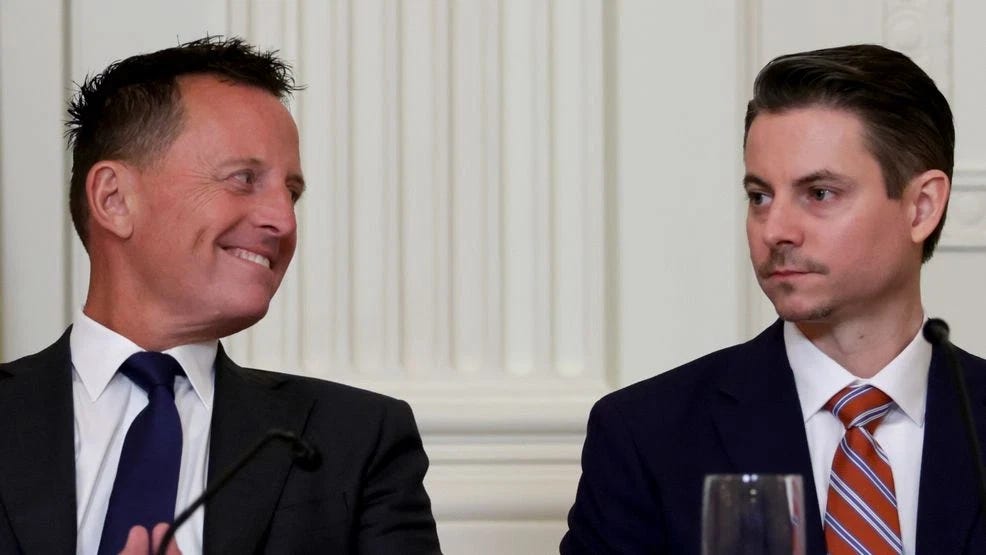
Matt Floca (R) with his predecessor as Kennedy Center president, Ric Grenell
Floca had been testifying about how, after joining the Kennedy Center in 2024 as vice president of facilities, he had witnessed water and other damage to the building accumulating. Putting off those repairs, he testified, posed safety threats to the building. These weren’t new issues, of course. They were mentioned in the hall’s master plans as early as 2021, with phased work contemplated.
President Trump himself had suddenly upset those plans on Feb. 1. On his Truth Social media site, he said the great performing-arts center had to close for two years in July 2026. This was to “turn it into a World Class Bastion of Arts, Music and Entertainment.” Never mind that it already had been just that for over half a century, back when the great Soviet-émigré cellist Mstislav Rostropovich first performed there. (I remember that vividly, watching awestruck with college friends from the upper-tier $2.50 student seats. That’s where my love for the Kennedy Center began.)
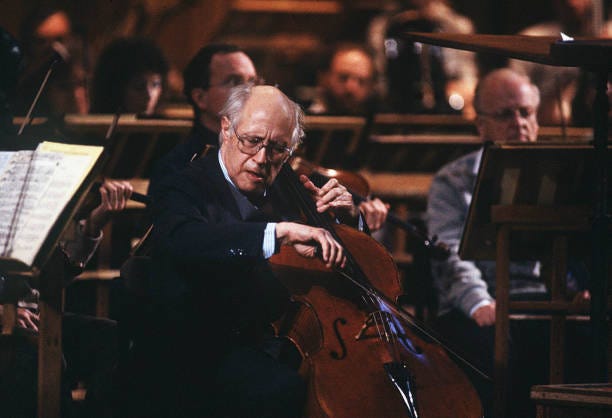
The great cellist Mstislav Rostropovich became music director of the National Symphony Orchestra at the Kennedy Center.
Trump claimed his decision stemmed from “a one year review” of the Kennedy Center “with Contractors, Musical Experts, Art Institutions, and other Advisors and Consultants.”
By March 13, President Trump fired the Kennedy Center president and installed Floca in the job. Three days later, Floca proposed the two-year closing to the center’s board. The trustees included Trump acolytes like Pam Bondi, Maria Bartiromo and Robert F. Kennedy Jr.
The remainder of 2026 performances would be wiped away. The entire 2026-27 season, too, will vanish. Much of the 2027-28 season, kablooey.
“This is an incredibly unique time,” he testified before Judge Cooper. “We have the time in our programming schedule to do this now.” Of course, it had this extra time because of the exodus of talent.
At that point, an attorney colleague, Nathaniel Zelinsky, describes Ms. Freeny as shambling up to the judge, lugging a thick file of papers, a real-life version of the television detective Columbo. “Your honor, may we address?” she asked. She was allowed a few questions that proved pivotal.
“You did not commission any study or cost estimates” of closing the hall versus phased work, she asked Floca.
“There is no need to,” he responded. He acknowledged that doing that work in phases to keep the center open was an option. But, he said, he regarded that as “irresponsible.” (Floca and the Kennedy Center press office didn’t respond to inquiries.)
“You don’t have a background in performing arts management, right?”
“That has nothing to do with closing the center for the needs of the building,” said Floca.
“You didn’t make an effort to quantify…what is it going to cost the center in lost revenue, in lost goodwill, in lost performances, if we do close for two years?” she asked.
“I did not directly make that, you know, do that review, no. My decision was focused on the needs of the building.”
Did you have any analysis of the loss of ticket sales? she asked.
“No, I didn’t have that information in front of me, no.”
“So you recommended to close the center based on what you saw as the efficiencies on the construction side, correct?”
“Yes,” he said. “But I would like to make it clear, I’m not oblivious to what’s happening on the programming side. I didn’t make the decision in a vacuum, if that’s what you’re asking.”
As a final point in her cross-examination, she noted that the Trump administration, in its most recent 2026 budget submission to Congress, hadn’t said anything about closing the center. She asked Floca about this.
“I think you’re just pointing out a clerical error in the submission,” he said. Meaning, no, they didn’t tell Congress about shuttering the place.
Judge Cooper concluded the case by issuing a preliminary injunction against closing the hall for two years, requiring the center to find a way to do both. He is still evaluating a final decision. Freeny and colleagues are seeking expert “discovery” testimony on the financial and reputation consequences of any closing.
As part of his order, Judge Cooper decided Floca “by his own admission” was focused solely on the building. Arts programming was simply “not a factor.
“He had served in the role of Kennedy Center executive director for all of a few minutes,” the judge said, “before suggesting that the institution be shut down for years.”
And Trump’s “one year review” of the great arts center? That review never happened, the judge found. Judge Cooper hasn’t yet said whether he will issue a permanent order requiring the Kennedy Center to stay open while doing the maintenance.
The national embarrassment at the vast empty hall now includes cancellation of multiple performances next season of at least six major plays and musicals like Back to the Future, Mrs. Doubtfire and the audience-participation barber-shop mystery show Shear Madness. Also at least one entire season of the National Symphony is at risk at the Kennedy Center. One person familiar with the matter says the symphony may play at George Washington University’s Lisner Auditorium and the Strathmore hall in suburban Maryland.
These losses are on top of the deluge of performers and shows backing out last season, like “Hamilton”, the San Francisco Ballet and violinist Hilary Hahn. Plus the Washington National Opera, which left in January amid artists’ departures and donor defections.
This casts a pall on the hall for many years to come.
“A closure announcement of the kind issued for the Kennedy Center does not simply defer future bookings,” the New York Philharmonic’s former president, Deborah Borda, told the court. “It may prevent the Kennedy Center from returning to the touring schedules of the world’s leading performers…A closure will further undermine the Kennedy Center’s reputation, which will take years to rebuild.”
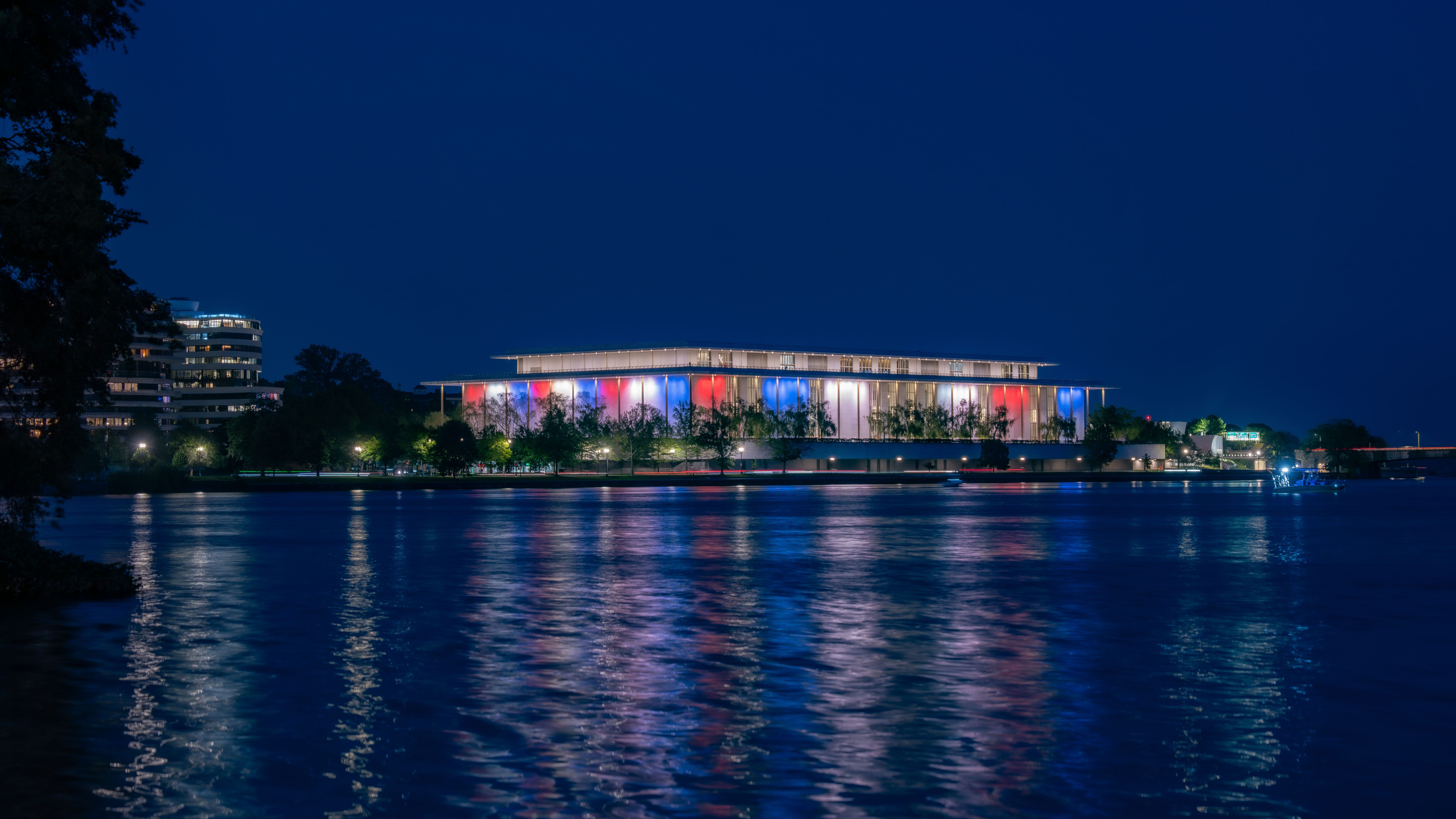
It’s still possible to catch a brief glimpse of what the Kennedy Center once was, though most is blocked off by security guards. Recently, I wandered through the imposing terrace-level museum devoted to the late president. Memorialized there, for instance, is the famous 1962 White House dinner the president hosted for 49 Nobel Prize winners.
By contrast, only “The John” and “Forming Arts” remain visible on the front portico, around the edge of the blue-and-white tarp .
Security guards apparently are under orders not to answer questions like, “So, is Trump’s name really gone?”
“Don’t know,” they say and shrug. Passing by the entrance, a Trump-ordered National Guard team patrols the scene.
If you like this article, please share and recommend — and see all my future posts. Unlike “opinion” newsletters, these will be deeply reported and take longer to do — but that’s why they’ll be unique and valuable.